A signature stamp can be a helpful tool for individuals and businesses that frequently sign checks. But before using one, an important question arises—are there legal standards that allow banks to accept stamped signatures? Understanding the rules can help you avoid rejected checks and prevent problems with financial transactions. In this article, we will discuss the key legal factors that influence the acceptance of a signature stamp and explain how banks evaluate them in practical situations.
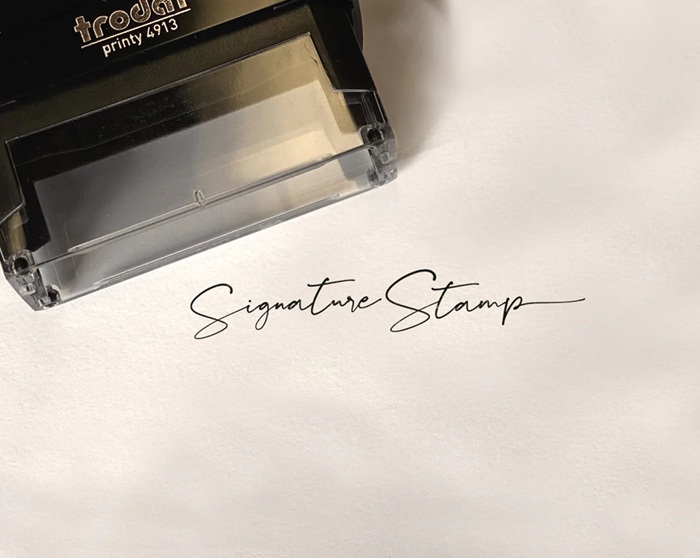
Are Signature Stamps Allowed for Check Signing?
Yes, signature stamps are generally allowed, but their acceptance depends on several legal and banking guidelines. The laws do not prohibit using a stamp for signing checks. Instead, the main requirement is that the account holder must authorize it. If the bank has record of approval, the stamped signature is treated as a valid form of signing. This applies to both personal and business accounts.
However, even though the law permits it, each bank may have its own procedures for approving the use of a stamp. So, customers should confirm whether their financial institution requires registration of the stamp before using it for transactions.
Authorization Requirements by Banks
Banks need confirmation that the account owner has permitted the use of a signature stamp. This is usually done by completing a written authorization form at the bank. The bank may also ask the account holder to provide a sample of the stamp. Once the document is submitted, the bank stores the record and uses it to verify future transactions.
If someone uses a stamp without authorization, the bank can reject the check. In some cases, the unauthorized use might even be considered fraud. Therefore, proper approval is a crucial step before using a stamp regularly.
Uniform Commercial Code (UCC) Guidelines
In many countries, banking transactions are guided by commercial laws. In the United States, the Uniform Commercial Code (UCC) plays an important role in regulating check signatures. According to the UCC, a signature can be made manually, using a machine, or with any symbol intended to represent the signer. This means a stamp can legally serve as a signature.
The UCC also states that the person whose name appears on the check is responsible for the transaction if they authorized the method of signing. Therefore, once the account holder approves the use of a stamp, the stamp carries the same legal weight as a handwritten signature.
Fraud Prevention Measures
Even though a signature stamp is permitted, banks prioritize safety. A stamped signature can be more vulnerable to misuse if not properly handled. To reduce risk, banks may apply additional verification methods, such as:
• Transaction history monitoring
• Signature comparison
• Limits on check amounts
• Verification by phone for large checks
These steps help the bank confirm that the check was issued by the rightful account holder. Customers using a stamp should store it securely and restrict access to trusted individuals.
Business vs. Personal Account Usage
Signature stamps are more common with business accounts where multiple checks are issued daily. Companies often authorize employees to use a stamp so that payments can be processed smoothly. But the authorization must be documented clearly. Businesses may also maintain internal logs that record who used the stamp and when.
For personal accounts, usage is less common but still acceptable. Individuals who have medical conditions, age-related limitations, or mobility challenges may rely on a stamp for convenience. Banks usually follow the same authorization process as they do for businesses.
Bank Policy Differences
While legal guidelines permit the use of signature stamps, each financial institution has the right to set its own policies. Some banks allow stamped signatures only for deposits, while others accept them for check signing once authorization is on file. A few banks may refuse the use of stamped signatures altogether.
This is why customers must communicate with their bank first. A conversation with the branch manager or customer service can clarify the institution’s requirements. Providing written permission and a sample stamp often resolves the issue.
Electronic and Automated Transactions
With the rise of digital banking, many payments no longer require physical signatures. Online transfers, bill payments, and automated clearing systems use verification methods such as PINs, one-time passwords, or biometric authentication.
Even though electronic payments reduce the need for a stamp, many organizations still rely on physical checks. In such cases, understanding the legal acceptance of a Signature Stamp For Checks Legal becomes important, especially for companies that issue high-volume payments.
Liability and Disputes
If a stamped check is misused, liability depends on authorization and negligence. If the account owner failed to secure the stamp properly, they may be responsible for losses. But if the bank made an error after authorization was properly recorded, the financial institution may be liable.
Disputes are usually handled under commercial banking laws and internal bank policies. Reporting unauthorized transactions quickly is important to reduce financial risk.
Conclusion
A signature stamp can legally be used to sign checks as long as the account holder authorizes it and the bank accepts it. The UCC permits stamps as valid signatures, and banks rely on written approval and verification procedures to process stamped checks safely. While many institutions support their use, policies differ, so communicating with the bank before using a Signature Stamp for Checks Legal is essential. With proper authorization and secure handling, a signature stamp can be a practical and reliable method for signing checks without facing transaction issues.
 For Insights
Leave a comment